The 1972 Managua earthquake destroyed the city
The 1972 Nicaragua earthquake occurred at 12:29 am on December 23 near Managua, the capital. It had a magnitude of 6.2, with the epicenter 28km northeast of the city centre. The earthquake caused widespread casualties among Managua’s residents: 6,000 were killed, 20,000 were injured and over 250,000 were left homeless. It destroyed or severely damaged much of the city centre.

Millions of dollars of aid were donated. President Anastasio Somoza Debayle diverted much of the money for himself and those close to him. Frustration grew into a revolt that became the Nicaraguan Revolution, in which Somoza was overthrown in 1979. A broad coalition of forces led by the Sandinistas overthrew the Somoza dictatorship that had ruled Nicaragua for 43 years. Healthcare reforms and a widely lauded Literacy Crusade, which cut illiteracy from more than 50% to 13% in two years, earned the revolutionary government accolades on the world stage.
Civil war further devastated the country
In 1981, in an attempt to overthrow the Sandinista government, the Reagan administration began illegally financing and training the contras, a mercenary army based in Honduras. The Soviet Union and Cuba funded the Nicaraguan army. Much of the country’s infrastructure was damaged or destroyed. When Congress moved to cut off aid to the Contras (1985), Reagan aide Col. Oliver North concocted a clandestine and ingenious plan to continue funding the Contras terrorists (Iran-Contra Affair). In 1986, the World Court ruled that the US war against Nicaragua was in violation of international law and ordered the US to pay $12bn reparations. The US refused. The contra war led to the death of 60,000 soldiers (half on each side) and 50,000 civilians between 1981 and 1990.
Due to the extent of the damage, corruption and the subsequent revolution and 11 year civil war, much of Managua city centre remained ruined for almost 20 years. Reconstruction only began in the 1990s. This was not co-ordinated and has led to a sprawling mess with no centre.

Between 1990 and 2007 a neo-liberal government brought significant change
Neo-liberal governments spread across the whole of Latin America at this time. In Nicaragua this included Liberal Arnoldo Alemán, voted one of the world’s 10 most corrupt politicians by the UN Human Rights subcommission. Alemán siphoned off US$100 million from the government.
During the neo-liberal years trade union power was diminished. This then allowed widespread privatisation. Thousands of public sector jobs were lost, the health service was underfunded and suffered from acute shortages. Until 2007, Nicaraguans in effect ceased to have access to free health care. Education, trains, telecommunications, electricity and even land was also privatised during this period.
Nicaragua is one of five countries in the world where abortion is illegal with very few exceptions.
Daniel Ortega (Sandinistas) returned to the presidency in 2006, bringing positive reforms.
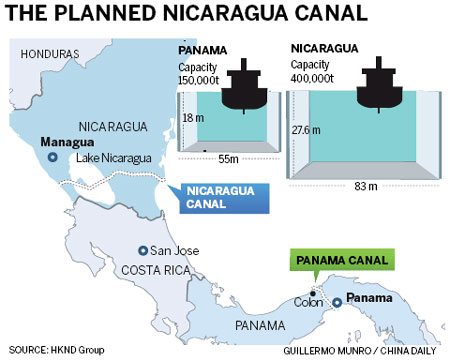
Nicaragua is the largest country in Central America, covering an area the size of Greece. It borders Honduras to the North and Costa Rica to the South. The Caribbean Sea (Atlantic Ocean) lies to the East and the Pacific Ocean is to the West. A canal linking the two oceans has recently begun construction. Costing US$50bn and developed by a Chinese company, it will be 172 miles long, 750-1700 feet wide and 90 feet deep. This compares with the 100 year old Panama Canal which is currently being upgraded to 50miles long, 180 feet wide and 90 feet deep. When complete in five years, the canal should double the country’s GDP.
There are 6 million people (45/km2) and half live in the Pacific region. A quarter of the total population live in the capital. Nicaragua is the second poorest country in the Western Hemisphere and half the country lives in poverty. 77% of the population in rural areas have an unsuitable water supply. 33% have no electricity and 59% use wood for cooking.
The new government has made significant improvements to salaries, healthcare and other areas. Health (treatment and prescriptions) and education are now free. Illiteracy has nearly been eliminated; maternal mortality and malnutrition rates have reduced by up to 50%. There has been a huge investment by the government in social programmes such as Zero Hunger.
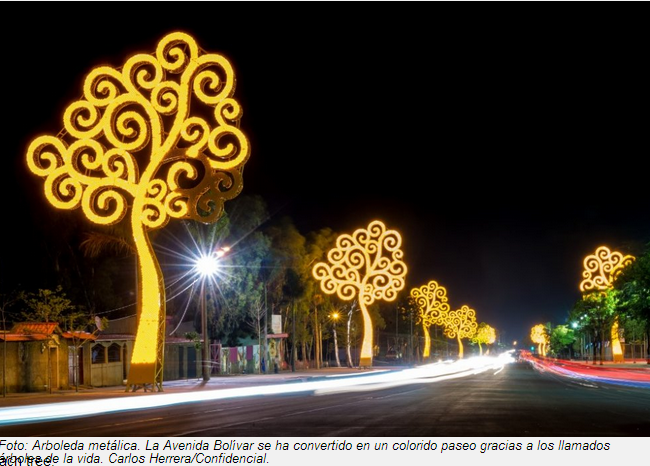
They have also improved the image of Managua with illuminated Trees of Life:
 s3bster's Blog